Research and Development
1
LLM Safety as a Quality Gate: Integrating Bias, Fairness, and Robustness Evaluation into CI/CD via GitHub Apps
A GitHub App that enforces LLM safety standards at the PR level the same way linters enforce code quality.
AI SafetyCI/CDGitHub AppOpen Source
LLM Eval Agent is the first open-source GitHub App that blocks unsafe models from merging — automatically evaluating bias, fairness, and adversarial robustness on every pull request, with confidence scoring and a full audit trail. Unlike standalone frameworks like EleutherAI Harness, DeepEval, or AIF360, it lives inside the developer workflow — no separate pipeline, no infrastructure, no manual triggers.
System Profile
- Native GitHub App with webhook-driven PR integration
- Automated bias & robustness evaluation on every PR
- Confidence scoring with per-metric breakdown
- Longitudinal audit logging across releases
Evaluation Stack
- LangTest (John Snow Labs) — active harness for bias, fairness & robustness tests
- HuggingFace Transformers — model loading and inference
- Bias tests: pronoun replacement (gender bias)
- Robustness tests: typo injection, dialect variation
- PR gate: GitHub Check Run with configurable pass-rate threshold (default 80%)
- Open source — Apache 2.0
Demo
LLM Eval Agent Demo
Open the live demo to see bias, fairness, and robustness evaluation running as a native GitHub App quality gate on pull requests.
2
ATI: Adaptive Test Intelligence — A Unified Modular Microservice for Flaky Test Detection, Cost-Bounded LLM Repair, and Configurable Autonomy in CI/CD
ATI (Adaptive Test Intelligence) is the first system to unify flaky test detection, cost-bounded LLM repair, and configurable autonomy under a single modular REST microservice.
Flaky Test DetectionLLM RepairCI/CDREST MicroserviceOpen Source
A live CI/CD harness across eight scenarios and seven error types confirms 100% repair rate at ≈19 s machine MTTR in Autonomous mode, eliminating unbounded human approval latency without degrading repair quality. All modules share a single SQLite persistence layer and are released as open-source under the Apache 2.0 licence.
System Profile
- 18 modules in a 7-stage pipeline
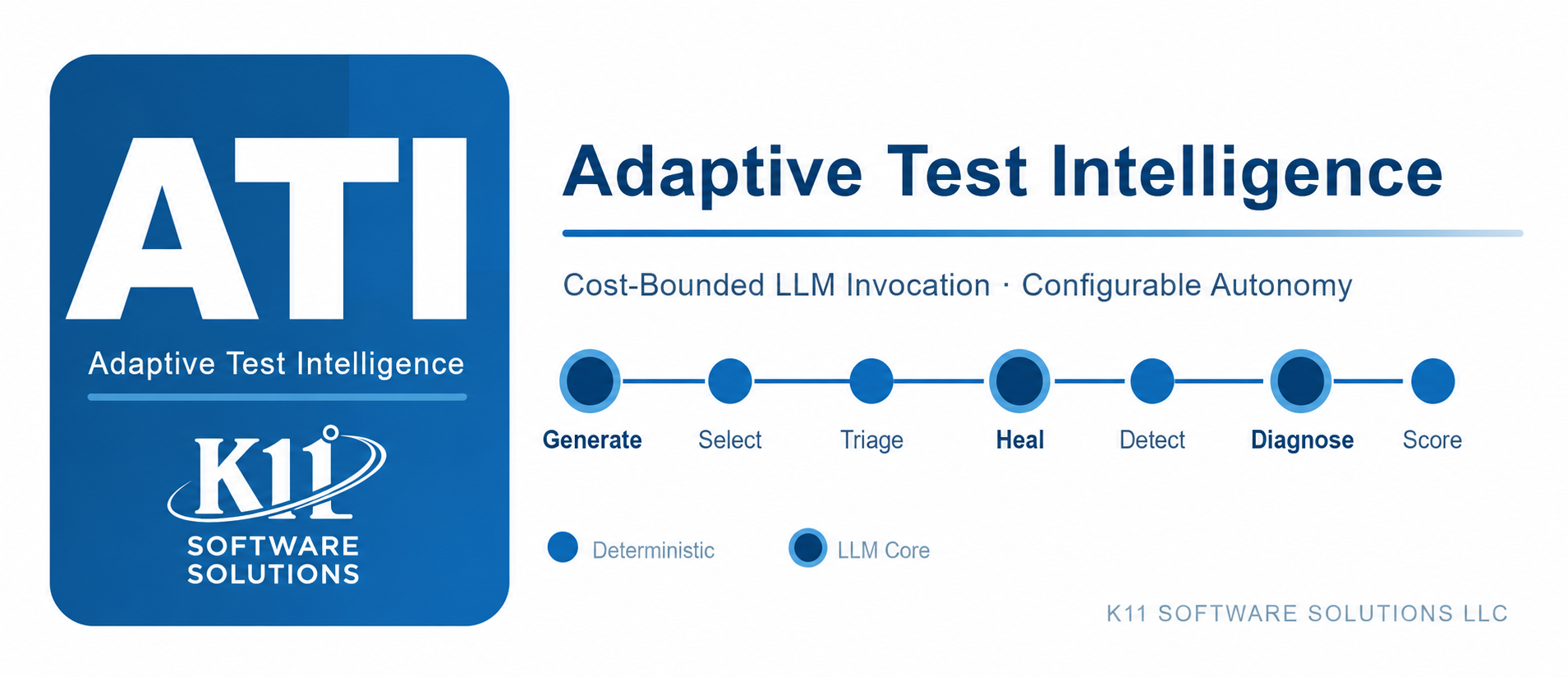
- Pipeline: Generate → Select → Triage → Heal → Detect → Diagnose → Score
- 4 LLM-invoking modules: ATG, SHA, RCA, VRH
- 14 fully deterministic modules
Autonomy & Results
- HSP gate bounds LLM cost on stable tests
- AutonomyMode dial: MANUAL / GATED / SUPERVISED / AUTONOMOUS
- 100% repair rate at ≈19 s machine MTTR (Autonomous mode)
- Apache 2.0 open-source
Demo
ATI: Adaptive Test Intelligence Demo
Open the live demo to see the 7-stage ATI pipeline, AutonomyMode controls, and cost-bounded LLM repair in action.
3
CASSET: Carbon-Aware Scheduling System for Eco-Tier Testing — Risk-Proportionate Agent Tier Routing and Grid-Intensity Deferral for Agentic CI/CD
CASSET is the first framework to jointly optimise defect detection and carbon footprint in agentic CI/CD — combining risk-proportionate tier routing with real-time grid-intensity deferral under a zero-modification adapter.
Carbon-Aware CI/CDAgentic TestingGreen SoftwareGSF Carbon Aware SDKOpen Source
World's first carbon-aware scheduler for agentic CI/CD — 38.7% carbon reduction, zero quality loss.
A five-phase evaluation across 180 real pull requests and 197 tests confirms 38.7% CI carbon reduction via tier routing and 52.4% grid intensity reduction via deferral, with zero defect detection impact (F1 = 0.931). The scheduler queries the Green Software Foundation Carbon Aware SDK to defer HIGH-tier agents to the lowest-carbon 30-minute window within a 6-hour horizon, with a hard fallback preventing unbounded latency. All components are released open-source under the Apache 2.0 licence.
System Profile
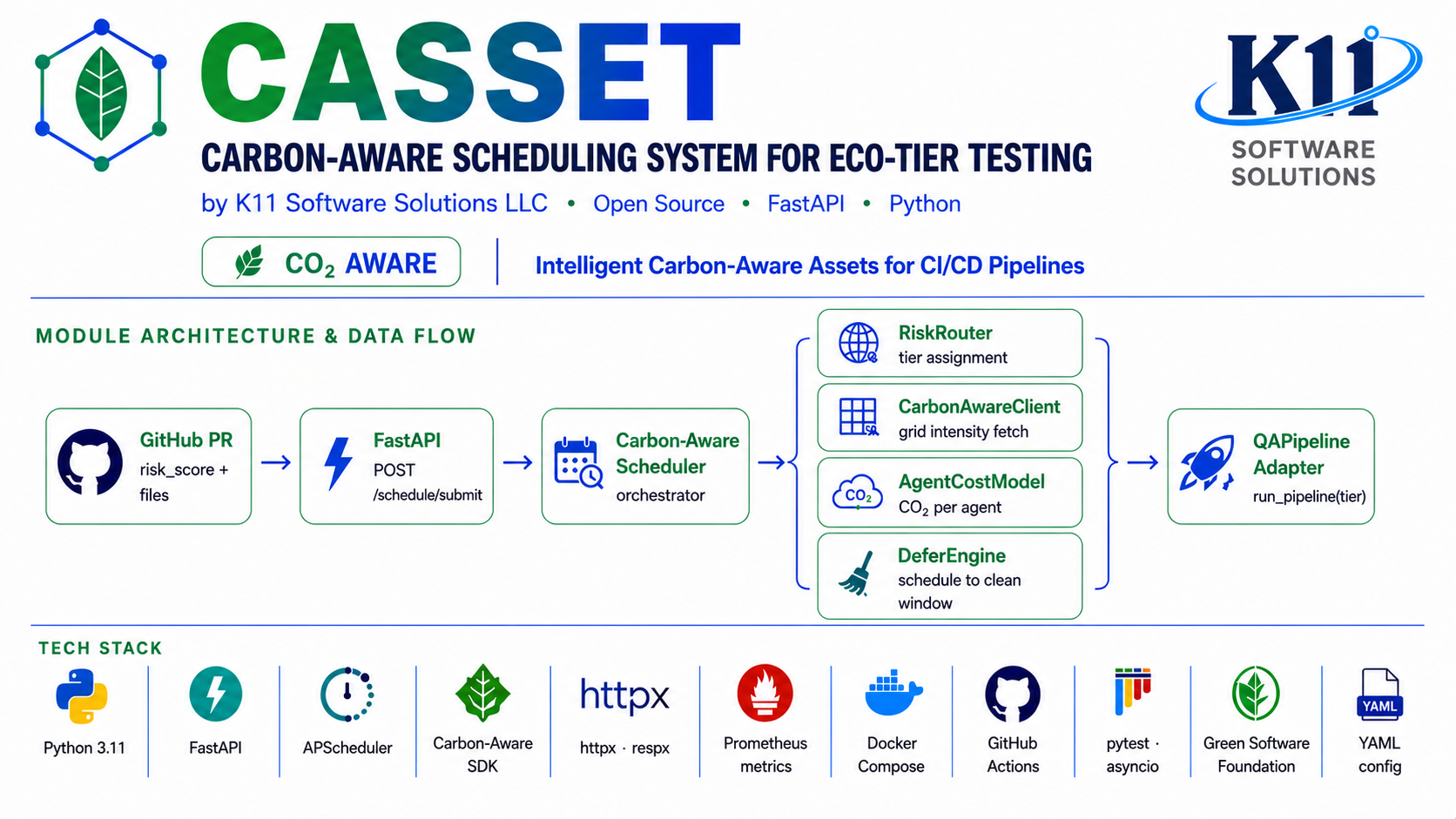
- 4-component pipeline: RiskRouter → CarbonClient → DeferEngine → QA Pipeline Adapter
- 5-feature risk scoring: lines changed, cyclomatic complexity, change history, dependencies, test coverage
- 4 risk tiers: LOW / MEDIUM / HIGH / CRITICAL
- CRITICAL PRs always run immediately — safety overrides sustainability
- Zero-modification adapter pattern — no changes to existing pipeline code
Carbon & Quality Results
- 38.7% CI carbon reduction via risk-proportionate tier routing (53.52 g → 32.82 g CO₂)
- 52.4% grid intensity reduction via deferral (420 → 199 g CO₂/kWh)
- 31.4% of baseline carbon saved (16.80 g CO₂) for HIGH/CRITICAL agents
- Median deferral latency: 2.1 hours
- F1 = 0.931 — identical to full-suite baseline
- 197 tests across 5 phases: unit, integration, agentic, E2E, carbon accounting
- Apache 2.0 open-source
Demo
CASSET: Carbon-Aware Scheduling Demo
Open the live demo to see risk-proportionate tier routing, real-time grid-intensity deferral, and carbon accounting across the agentic CI/CD pipeline.
4
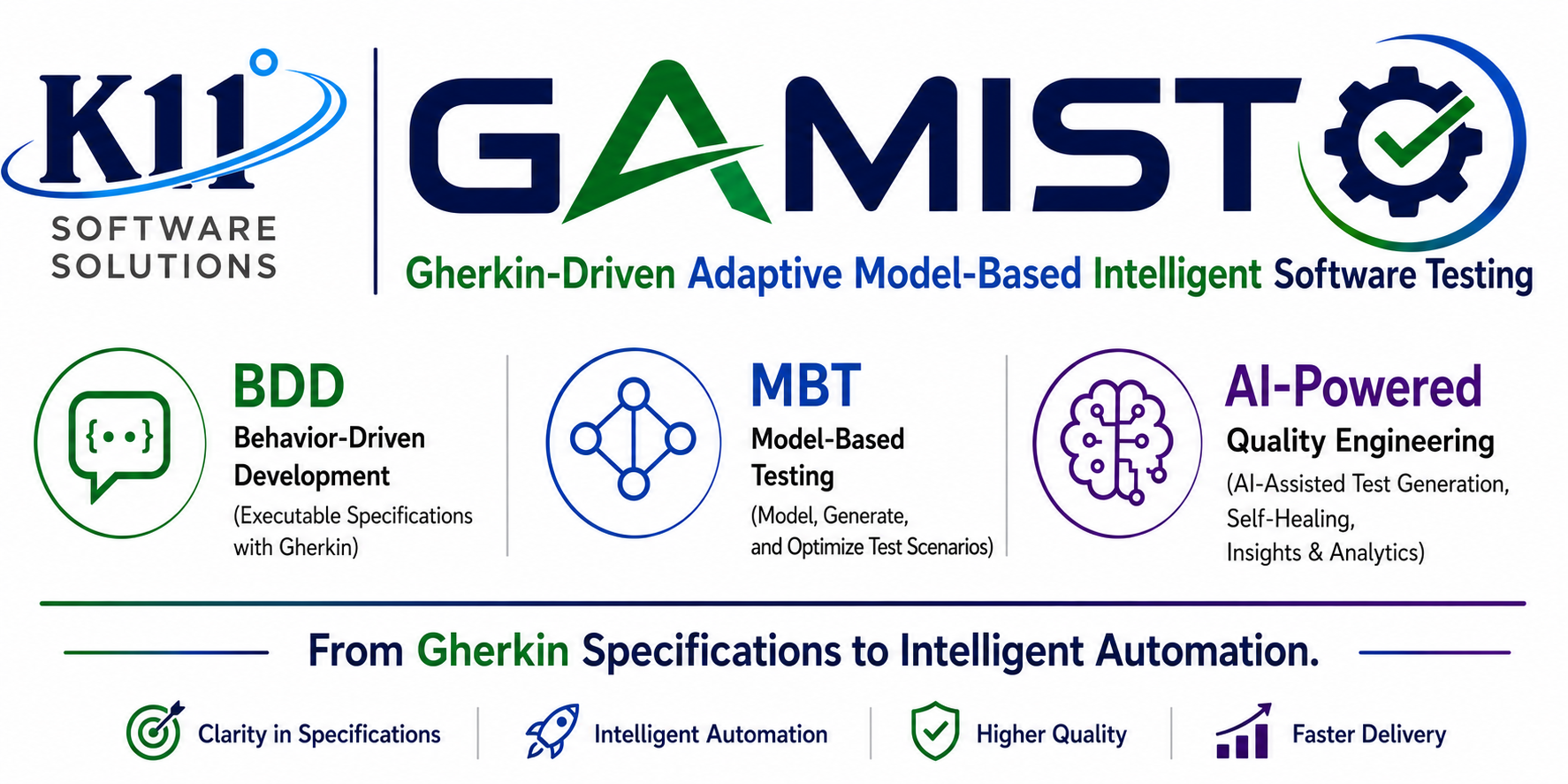
GAMIST: Gherkin-Driven Adaptive Model-Based Intelligent Software Testing — Automating Test Model Generation from BDD Scenarios with AI-Assisted Coverage Improvement
An AI-powered quality engineering platform that transforms natural language requirements into executable Gherkin specifications, model-based workflows, and adaptive automated tests.
BDDMBTGraphWalkerPAP SynthesisLLM Gap Detection
GAMIST is the first open-architecture framework to automate the full BDD-to-MBT pipeline — from Gherkin scenario parsing to GraphWalker JSON model generation — with LLM-driven coverage gap detection and risk-proportionate test path recommendations, deployable across any domain without model re-authoring.
The base framework combines 9 framework modules, 3 domain modules, a PAP synthesizer producing 20 vertices and 25 edges from 37 scenarios, MbtCoverageAdvisor, and CoverageGapLoop to coordinate cross-domain test coverage with measurable synthesis accuracy and production-readiness signals.
System Profile
- 9 framework modules — framework-core (mandatory: WebDriver, Cucumber BDD, step definitions, hooks); framework-data, framework-ai, framework-reporting, framework-security, framework-visual, framework-performance, framework-microservice, framework-device (all optional, plug-in per domain)
- 3 domain modules — domain-k11 (★ evaluated, 37 scenarios); domain-trading (baseline, 7 vertices · 11 edges, hand-crafted); domain-ecommerce (planned, multi-domain expansion)
- PAP Synthesizer — Precondition-Action-Postcondition algorithm maps Given → source vertex, When → edge chain with guard on first edge, Then → target vertex; executed by BddToMbtSynthesizer + GraphWalkerJsonWriter
- AI/LLM layer — MbtCoverageAdvisor detects uncovered edges via CoverageGapLoop; EdgeProposal schema structures LLM gap recommendations; StepNormalizer converts free-text Gherkin steps to canonical vertex/edge identifiers
- Test execution stack — Selenium 4 (web), Appium (mobile), Playwright for Java (cross-browser); Pact contract testing (framework-microservice); visual regression (framework-visual); performance (framework-performance)
Evaluation Results
- SSRR = 0.54 — Step-to-State Reduction Ratio (37 steps compressed to 20 states)
- ERR = 0.08 — Edge Redundancy Rate (low duplicate path generation)
- MC = 65% — Model Coverage achieved on domain-k11 graph
- GIA = 100% — Guard Injection Accuracy (all 10 guards correctly placed on synthesized edges)
Demo
GAMIST: BDD-to-MBT Synthesis Demo
Open the live demo to see BDD-to-MBT synthesis, GraphWalker model generation, and LLM-driven coverage gap detection in action.
5
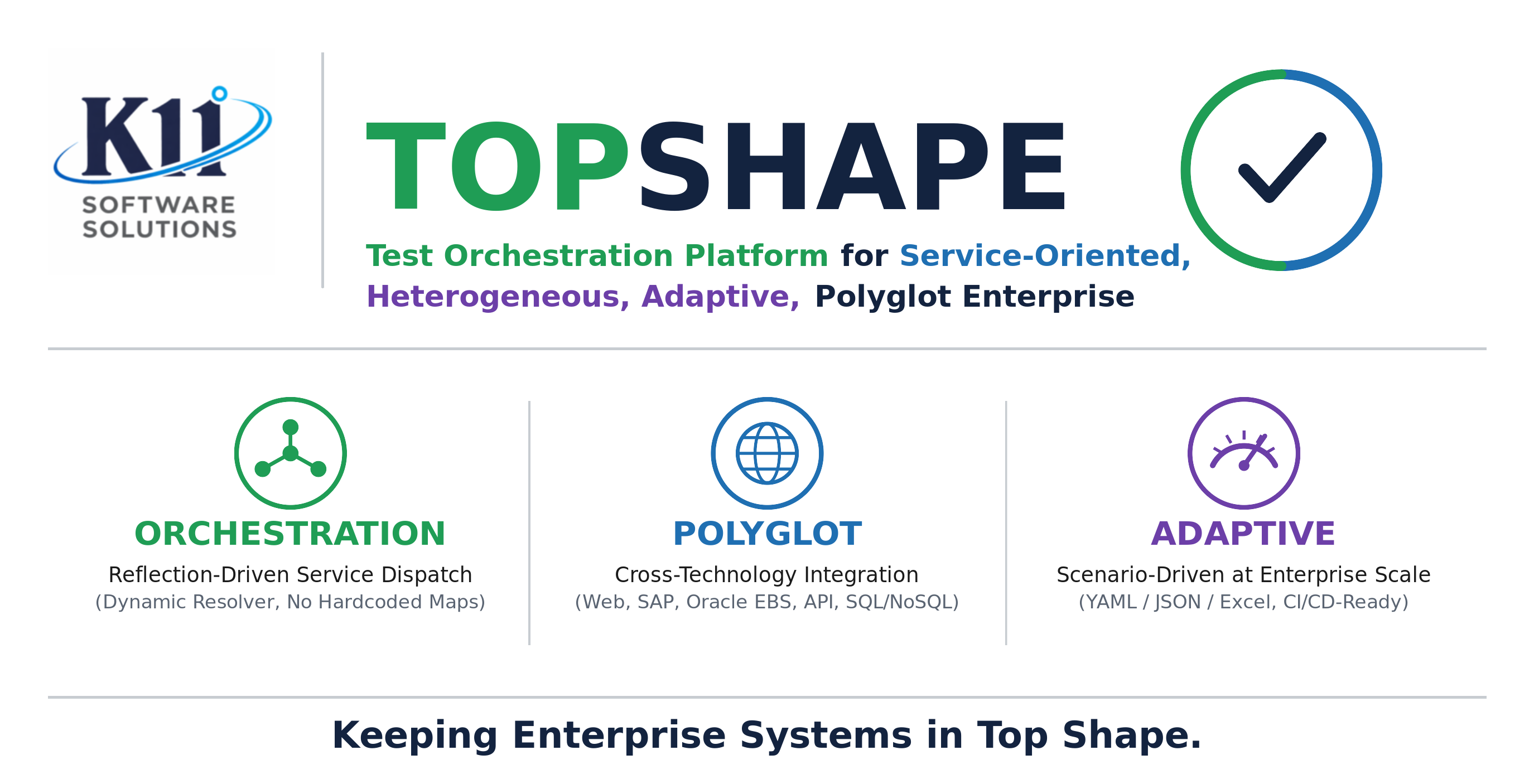
TOPSHAPE: Test Orchestration Platform for Service-oriented, Heterogeneous, Adaptive, Polyglot Enterprise Systems — Dynamic Test Orchestration for Real-World Business Workflows at Scale
K11 Software Solutions' Java service-orchestration framework — a reflection-driven dispatch architecture that resolves every test step to its driver class at runtime, unifying Web, Mobile, SAP GUI/Oracle EBS, API, database, and batch execution under one dynamic dispatch engine.
Java Reflection-Based DispatchService OrchestrationSAP GUI / Oracle EBSEnd-to-End Testing
TOPSHAPE is a reference architecture for unifying legacy desktop/ERP automation with modern Web, API, database, batch, and messaging test layers under one dynamic dispatch mechanism and one shared execution context — driven by a single externally authored scenario file, resolved end-to-end with zero per-technology orchestration code.
The reference implementation combines a reflective ServiceResolver, a shared TestContext, a recursive ParamResolver, six technology-specific driver bases, and three client/driver factories to take a scenario from authoring to execution with convention-plus-override dispatch and cross-step data flow.
System Profile
- 6 technology-specific driver bases (Web, Mobile, Desktop/ERP, API, DB, Batch)
- Reflection/MethodHandle-based dynamic dispatch — no static keyword-to-class map
- Externally authored scenarios (YAML / JSON / Excel)
- Shared cross-step TestContext with recursive ${env:}/${data:}/${runtime:}/${context:} resolution
- Three centralizing factories (UI / Web-service client / DB client) for declarative driver construction
- CLI-driven CI/CD entry point (TestLauncher)
- Per-step duration capture with structured reporting design (MongoDB test_runs schema, Allure/ExtentReports artifacts)
Verification Stack
- Independent Python cross-check of ServiceResolver and ParamResolver logic, verified against expected Java behavior
- JUnit 5 suite covering TestContext, ParamResolver, ServiceResolver, and full-scenario integration
- Negative-path testing — failures surface as named, debuggable exceptions rather than silent or opaque errors
- Qualitative comparison against Robot Framework, Cucumber, Karate, and Citrus across 8 capability dimensions
- mvn clean test on JDK 17 — next verification milestone, ahead of validation across TOPSHAPE's full polyglot enterprise stack (SAP GUI, Oracle EBS, REST/SOAP, SQL/NoSQL, batch/messaging)
Demo
TOPSHAPE: Dynamic Test Orchestration Demo
Open the live demo to see reflection-based dynamic dispatch, cross-technology scenario execution, and shared TestContext resolution in action.
6
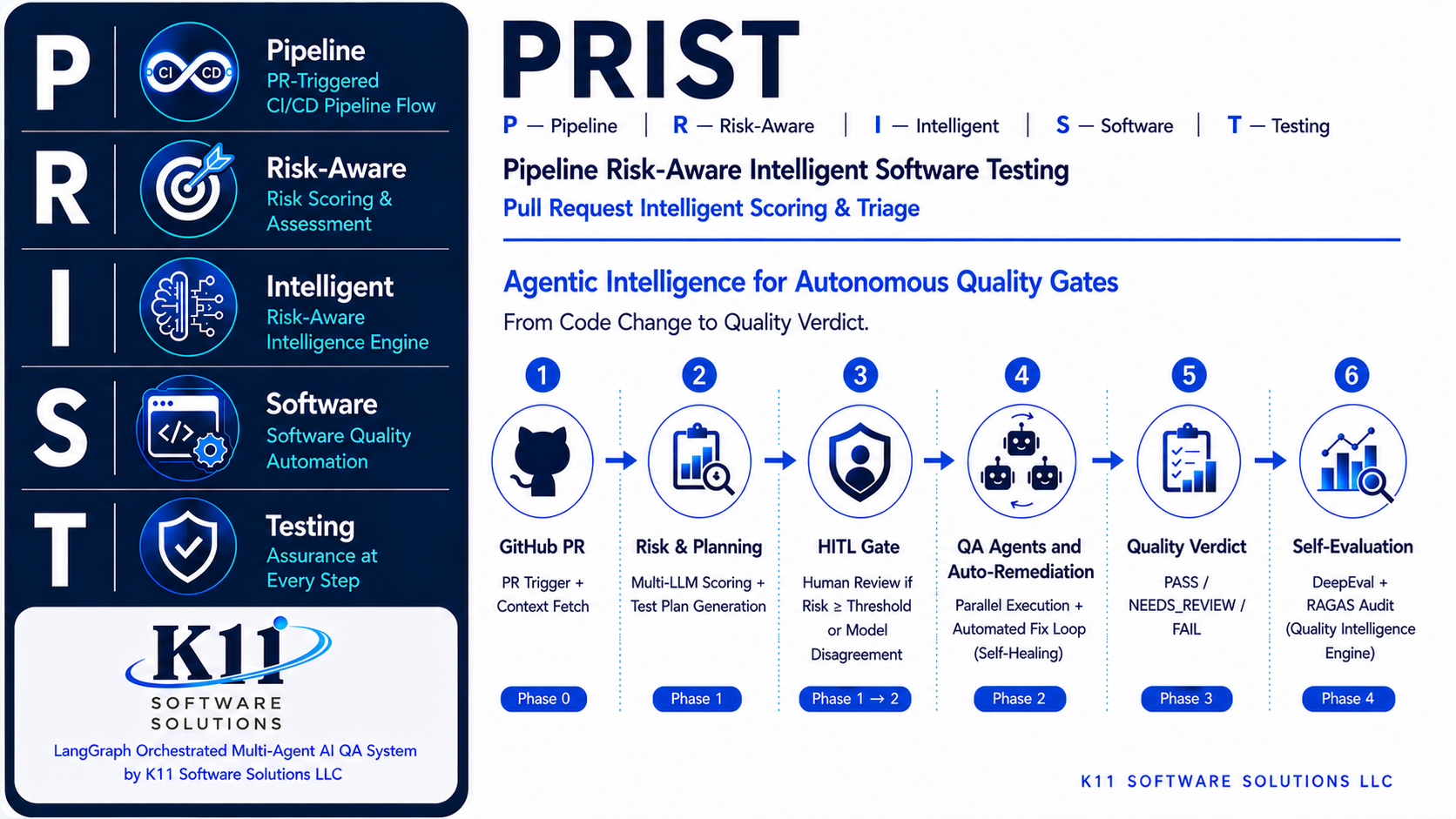
PRIST: Pipeline Risk-Aware Intelligent Software Testing — Autonomous CI/CD Quality Assurance Using LangGraph Multi-Agent Orchestration and Risk-Proportionate Human-in-the-Loop Control
K11tech Agentic AI QA System, a LangGraph-orchestrated multi-agent framework that autonomously executes a complete CI/CD quality gate — from pull request analysis to defect filing — without requiring manual QA intervention for routine changes.
LangGraphMulti-AgentCI/CDAutonomous QAHuman-in-the-Loop
PRIST is the first production-deployable CI/CD quality gate to combine risk-proportionate multi-agent testing, stateful human oversight, and LLM self-evaluation in a single automated pipeline — triggered by a pull request, resolved without human intervention for routine changes.
The base system combines 14 agents, 7 MCP servers, parallel dispatch, a human-in-the-loop gate, DeepEval, and RAGAS to coordinate software delivery checks with measurable risk control and production-readiness signals.
System Profile
- 14 specialized agents
- 7 MCP servers
- Parallel dispatch execution
- Risk-proportionate HITL control
Evaluation Stack
- DeepEval for automated quality checks
- RAGAS for retrieval and answer assessment
- Controls tuned to delivery risk
- Traceable demo workflow
Demo
PRIST: Pipeline Risk-Aware Intelligent Software Testing Demo
Open the live demo to see the LangGraph orchestration flow, quality gates, and human-in-the-loop control in action.
7
Beyond Static Gates: Closing the Detect-Fix-Learn Loop in Agentic CI/CD Quality Assurance
This research work extends the K11tech Agentic AI QA System — a LangGraph-orchestrated 14-agent pipeline with three interlocking innovations that close a detect-fix-learn feedback loop and transform the static quality gate into a continuously self-improving system.
Consensus Risk Scoring, Automated Remediation, and Adaptive HITL Threshold Learning
Detect-Fix-LearnConsensus Risk ScoringAuto-RemediationAdaptive HITLLangGraph
This work extends Paper 5 by introducing adaptive decision controls that quantify uncertainty, learn from reviewer outcomes, and close the loop through autonomous fix generation.
Three Innovations
- Multi-LLM Consensus Gate (epistemic uncertainty signal)
- Adaptive Risk Threshold (online learning from reviewer decisions)
- Auto-Remediation Agent (detect to fix loop closure)
Demo
Beyond Static Gates: Detect-Fix-Learn Demo
Open the interactive demo to explore consensus risk scoring, automated remediation, and adaptive HITL threshold learning.
8
System-Level Impact Analysis for Microservice CI/CD via Cross-Repository Dependency Graphs
K11tech Microservice QA System, a LangGraph-orchestrated agentic pipeline that extends single-repository quality assurance to distributed microservice systems by maintaining a cross-repository view of API contracts and service dependencies.
Extends the knowledge store to capture inter-service API contracts, enabling downstream impact analysis from a single PR trigger.
Microservice QALangGraphCross-RepositoryAPI ContractsImpact Analysis
System Profile
- Extracts versioned API contracts from PRs (OpenAPI 3.x, gRPC Protocol Buffers, GraphQL)
- Stores contracts in a persistent Contract Registry MCP server
- Traverses directed dependency graph to identify all downstream consumers of changed endpoints
- Dispatches parallel ContractComplianceAgents to validate each consumer's compatibility before merge
- Cross-repository HITL gate triggers on impact score thresholds; files GitHub issues in provider and consumer repos on breaking changes
- Open source — deployable alongside k11techlab-agentic-ai-qa-system as a complementary cross-repository quality gate
Evaluation Results
- 74 real-world pull requests across two evaluation phases
- Phase A: 100% P/R/F1 on 15 controlled scenarios across 4 k11techlab services, 3 pipeline tiers (diff-only, graph+diff, LLM-validated)
- Phase B: 100% P/R/F1 on 59 external OSS PRs across 4 open-source repositories — zero false positives
- Claude Haiku 4.5 optimal backend: 31% faster than Sonnet 4.6 (8.9 s vs 12.9 s mean latency)
- Only model achieving 100% accuracy on ambiguous consumer-impact scenarios
Demo
K11 Tech Lab Microservice QA Demo
Open the interactive demo to see cross-repository dependency graph traversal, contract compliance checks, and impact-proportionate human-in-the-loop gates in action.
9
Beyond Binary Verdicts: Aleatoric Uncertainty Quantification in Agentic CI/CD Quality Pipelines
This research work extends the K11tech Agentic AI QA System and K11tech Microservice QA System with six uncertainty-aware features (F1–F6) that propagate per-agent confidence through the pipeline and expose it to human reviewers in a principled way.
Uncertainty QuantificationAleatoric UncertaintyConfidence PropagationCI/CDHuman-in-the-Loop
Continuous integration pipelines that rely on LLM-based quality agents produce binary pass/fail verdicts that discard the probabilistic uncertainty inherent in model inference. This research extends the Agentic AI QA System with six uncertainty-aware features.
Six Uncertainty-Aware Features
- F1 — Per-agent confidence scoring via verbally elicited LLM self-assessment
- F2 — Weighted aggregation of agent scores into a pipeline-level uncertainty score
- F3 — Verdict downgrading: automatically converting PASS to PASS_UNCERTAIN when confidence falls below a calibrated threshold
- F4 — A second HITL escalation path triggered by high uncertainty rather than breaking-change detection alone
- F5 — Isotonic regression recalibration of raw LLM confidence scores against historical ground truth
- F6 — Correlation-aware aggregation that discounts redundant agent signals using a learned inter-agent correlation matrix
Evaluation Results
- 120-PR synthetic dataset calibrated to empirical agent accuracy distributions
- Combined features reduce unnecessary HITL escalation by 18% vs a binary-verdict baseline
- False negative rate maintained below 0.10
- Isotonic recalibration reduces expected calibration error from 0.14 to 0.06
Demo
K11 Tech Lab Agentic QA Uncertainty Demo
Open the interactive demo to explore aleatoric uncertainty quantification, per-agent confidence propagation, and principled human reviewer exposure.
10
Beyond a Single Threshold: Uncertainty Source Classification and Type-Stratified Conformal Prediction for Agentic CI/CD
This research introduces Uncertainty Source Classification: a two-category taxonomy (DATA_UNCERTAINTY, SCOPE_UNCERTAINTY) and a secondary LLM classification prompt that identifies which applies for each flagged consumer verdict in the K11tech Agentic AI QA System and K11tech Microservice QA System. Classification runs concurrently at O(n) LLM calls, adds zero pipeline latency, and never blocks the HITL gate. The two categories exhibit measurably different calibration characteristics, enabling type-stratified conformal prediction thresholds that reduce unnecessary HITL escalation.
Uncertainty Source ClassificationDATA_UNCERTAINTYSCOPE_UNCERTAINTYConformal PredictionCI/CD
Agentic CI/CD pipelines that produce confidence-gated verdicts tell reviewers that an agent is uncertain — but not why. Two structurally different causes of uncertainty produce identical low confidence scores yet demand different reviewer actions: DATA_UNCERTAINTY (aleatoric — evidence is genuinely ambiguous) calls for closer diff review, while SCOPE_UNCERTAINTY (epistemic — the agent lacks domain knowledge) calls for escalation to a domain specialist.
Uncertainty Taxonomy
- DATA_UNCERTAINTY — aleatoric: evidence is genuinely ambiguous; calls for closer diff review.
- SCOPE_UNCERTAINTY — epistemic: agent lacks domain knowledge; calls for domain specialist escalation.
- Classification runs concurrently at O(n) LLM calls, adds zero pipeline latency.
Evaluation Results
- Type-stratified conformal prediction thresholds reduce unnecessary HITL escalation by 23%.
- Coverage guarantees preserved (FNR ≤ 0.10).
- 120-PR controlled dataset, 42 classified verdicts.
- Inter-rater reliability κ = 0.81 — taxonomy is operationally stable.
Demo
K11 Tech Lab QA Uncertainty Source Demo
Open the interactive demo to explore uncertainty source classification, type-stratified conformal prediction thresholds, and DATA vs SCOPE uncertainty routing in action.